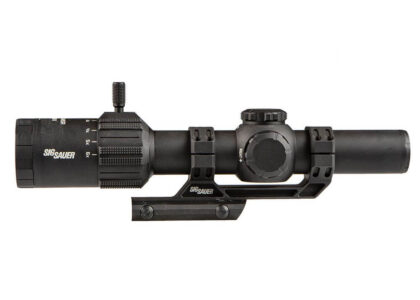
Rifle scope numbers explained in plain English: that is what this guide is for. Every scope listing is full of numbers like 4-16×44, 30mm, FFP and 0.25 MOA. They can look confusing at first. However, once you know what each one means, comparing scopes becomes easy. Let’s go through them one by one.

Rifle scope numbers explained: magnification
Take a 4-16×44 scope as an example. The first part, 4-16x, is the magnification range. At 4x, the target looks four times closer than it does to your eye. Similarly, at 16x, it looks sixteen times closer. A scope with a single number, such as 4×32, is a fixed power scope with one setting.
Lower power gives a wider field of view, which helps on moving or close targets. Higher power helps you place precise shots at long range.
Objective lens: the last of the rifle scope numbers
The number after the x is the objective lens diameter in millimetres. For example, a 4-16×44 scope has a 44mm front lens. A bigger lens gathers more light, which helps at dawn and dusk. On the other hand, it also adds weight and may need taller rings.
Tube size
Next, the tube is the main body of the scope. Most scopes use a 1 inch, 30mm or 34mm tube. A larger tube usually gives more room for elevation adjustment, which matters for long-range shooting. Make sure your rings match the tube size of your scope.
FFP vs SFP
These letters describe where the reticle sits. In a first focal plane (FFP) scope, the reticle grows and shrinks as you zoom. As a result, the hash marks stay accurate at every magnification. In a second focal plane (SFP) scope, the reticle stays the same size. The marks are only accurate at one magnification, usually the highest. FFP suits long range and holdovers, while SFP is simple and popular for hunting.
MOA vs MIL
MOA and MIL are two ways of measuring angles, and they describe how the turrets adjust. One MOA is roughly 1 inch at 100 yards. By contrast, one MIL is 3.6 inches at 100 yards. Most MOA scopes adjust in 1/4 MOA clicks, while most MIL scopes adjust in 0.1 MIL clicks. In practice, neither is better. What matters most is that your reticle and turrets use the same system.
Parallax and eye relief
Parallax is when the reticle seems to move on the target as you move your head. Many scopes have a side focus or adjustable objective (AO) to remove it at different distances. Finally, eye relief is the distance between your eye and the scope where you get a full picture. Around 3.5 inches or more helps keep the scope away from your eye under recoil.
Rifle scope numbers explained: frequently asked questions
What does 3-9×40 mean on a scope?
It means the scope zooms from 3x to 9x and has a 40mm objective lens. In fact, this is one of the most popular hunting scope sizes.
Is more magnification always better?
No. Too much magnification narrows your view and makes it hard to find a target quickly. For most hunting, 3x to 12x is plenty.
Should I choose FFP or SFP for hunting?
For most hunting, SFP is simple and works well. However, if you use reticle holdovers at different magnifications, FFP is easier.
Rifle scope numbers explained: a quick checklist
- Hunting in woods: 2-7x or 3-9x, 32mm to 40mm lens, SFP.
- General hunting: 3-9x or 4-12x, 40mm to 44mm lens.
- Long range: 4-16x or higher, 50mm lens, FFP, 30mm or 34mm tube.
- AR and fast shooting: a 1-6x or 1-8x LPVO.
Now that you have the rifle scope numbers explained, you can compare models with confidence. Browse our rifle scopes, including hunting scopes and long range scopes. For more background, see the telescopic sight article. If you still have questions, contact our team.