

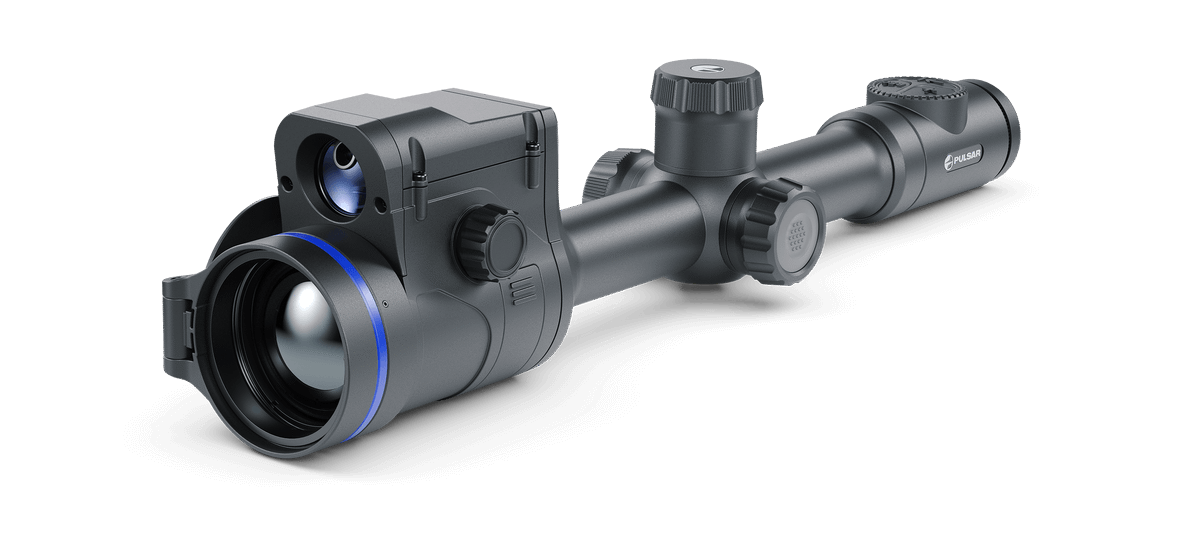
Buying your first thermal scope can feel confusing. Every listing is full of numbers like 384×288, 12 µm, 50 Hz and NETD <25 mK, and the prices range from around a thousand dollars to well over eight thousand. This guide explains how to choose a thermal scope in plain language, so you can match the specs to the way you actually hunt and avoid paying for features you will never use.
How a thermal scope works
A thermal scope does not need any light. Instead, it reads the heat that animals, people and objects give off, and turns those small temperature differences into an image on a tiny screen inside the scope. As a result, a hog in the brush or a coyote at the edge of a field stands out clearly, even on a pitch-black night or through light fog and smoke.
That is the main difference from digital night vision, which needs some light or an infrared illuminator. Thermal is better for finding animals. Night vision often shows more detail of the surroundings. Many hunters use a thermal scope on the rifle and a handheld monocular for scanning.
1. Sensor resolution: 384 or 640?
The sensor is the heart of the scope, and its resolution has the biggest effect on image quality and price.
- 384×288: the most popular choice for hog and coyote hunting. It gives a clear image at typical night-hunting distances and keeps the price lower.
- 640×480 or 640×512: about 2.8 times more pixels. The image stays sharper when you zoom in, and it is easier to identify animals at longer range. If you shoot open fields or want the best picture, a 640 sensor is worth it.
- 1024 and above: found on top-end models. Excellent detail, but most hunters do not need it.
As a rule, buy the best sensor you can afford before you spend extra on other features.
2. Pixel pitch: 12 µm vs 17 µm
Pixel pitch is the size of each pixel on the sensor. Most modern scopes use 12 µm sensors. A smaller pitch gives you more magnification from the same lens, so a 12 µm scope with a 35 mm lens reaches further than an older 17 µm scope with the same lens. Also, 12 µm sensors usually make the scope smaller and lighter.
3. Sensitivity (NETD)
NETD tells you how small a temperature difference the sensor can detect. It is measured in millikelvin (mK), and lower is better.
- Under 50 mK: good for most hunting.
- Under 40 mK: very good. Clearer detail in rain, fog or high humidity.
- Under 25 mK: excellent. Found on premium models.
Sensitivity matters most on humid nights, in the rain, or when the temperature difference between animal and background is small.
4. Lens size and magnification
The objective lens controls how far you can see and how wide your view is.
- 25–35 mm: lower base magnification and a wide field of view. This is great for hogs in thick cover and for fast follow-up shots at close to medium range.
- 40–50 mm: more reach and a narrower view. This is better for coyotes across open fields and longer shots.
- 60 mm and up: for long-range observation and shooting.
Keep in mind that digital zoom only enlarges the pixels. The image gets softer as you zoom in. For this reason, base (optical) magnification is more important than the maximum zoom number in the listing.
5. Refresh rate
Choose a scope with a 50 Hz or 60 Hz refresh rate. A higher refresh rate gives a smooth image when you track a running animal or pan across a field. Slower refresh rates can look choppy.
6. Laser rangefinder and ballistic calculator
A built-in laser rangefinder (LRF) tells you the exact distance to the animal. Many scopes link it to a ballistic calculator, so the aiming point adjusts for the range. This is very useful at night, because judging distance in a thermal image is hard. An LRF adds cost, but if you shoot past 150 yards it is one of the most useful upgrades.
7. Battery life and power
Look at how long the battery lasts and whether you can swap it in the field. Some scopes use an internal battery only. Others use removable packs or common 18650 cells, so you can carry a spare. If you sit out all night, plan for at least 6–8 hours, or carry spare batteries or an external power bank.
8. Recording, app and other features
- Video recording: many scopes record video, and some start recording automatically when you fire.
- Wi-Fi app: lets you stream the view to a phone, share footage and update firmware.
- Colour palettes: white-hot, black-hot and colour modes help in different conditions.
- Picture-in-picture: shows a zoomed view of the reticle area while you keep the full field of view.
9. Recoil rating, mount and weather resistance
Check that the scope is rated for the recoil of your rifle. Many scopes list a rating in joules or a maximum calibre. Also look for an IP67 rating or similar, which means the scope is protected against rain and dust. Finally, check the mount. Most thermal scopes come with a Picatinny mount, and some use 30 mm rings like a day scope.
Which thermal scope is right for you?
Hog hunting at close to medium range
A 384 sensor with a 25–35 mm lens is usually the sweet spot. You get a wide view for groups of hogs and fast target pick-up. Good examples are the Sightmark Wraith Mini 2-16×35 and the PARD SA3235, which also has a built-in rangefinder.
Coyotes and open fields
Step up to a 640 sensor or a lens of 40 mm or more. You can identify animals further out and use more zoom before the image breaks up. Look at the AGM Rattler V2 35-640 or the Pulsar Thermion 2 XQ50 Pro.
Long range and serious use
For the longest shots, choose a 640 sensor with a 50 mm lens and a rangefinder. Strong options are the Pulsar Thermion 2 LRF XP50 Pro, the AGM Secutor LRF 50-640 and the N-Vision HALO-LR.
Check your local hunting laws
Rules for hunting at night and using thermal optics vary by state and by species. Some states allow thermal for hogs and predators but not for game animals. Always check your state wildlife agency’s regulations before you hunt.
Quick checklist
- Sensor: 384 for most hunting, 640 for open country and longer range.
- Pixel pitch: 12 µm for more reach in a smaller package.
- NETD: under 40 mK if you hunt in humid or wet conditions.
- Lens: 25–35 mm for close cover, 40–50 mm for open fields.
- Refresh rate: 50 Hz or higher.
- Rangefinder: worth it if you shoot past 150 yards.
- Battery: enough for a full night, or a way to swap it.
- Recoil rating and IP67 weather protection.
Still not sure which scope fits your hunting? Browse our full range of thermal rifle scopes or contact our team, and we will help you compare models before you order.